High on the wish list
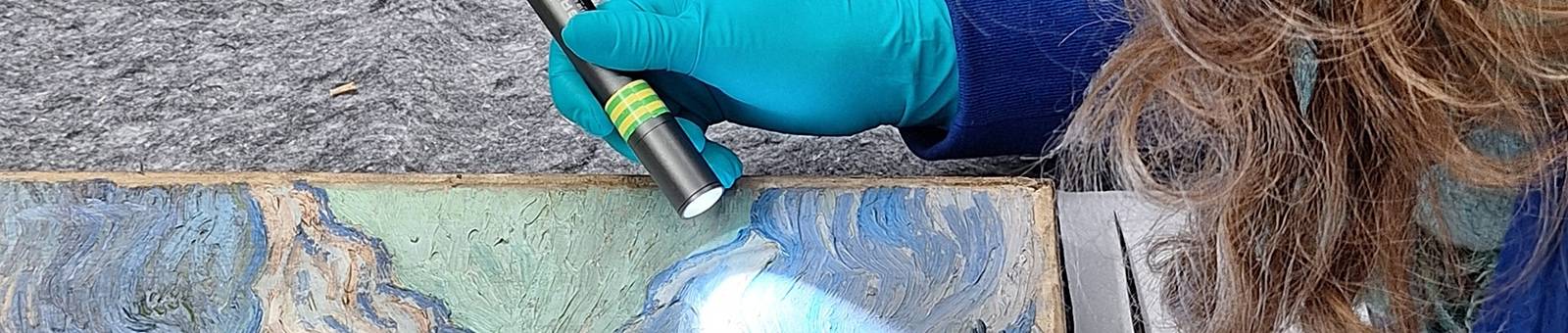
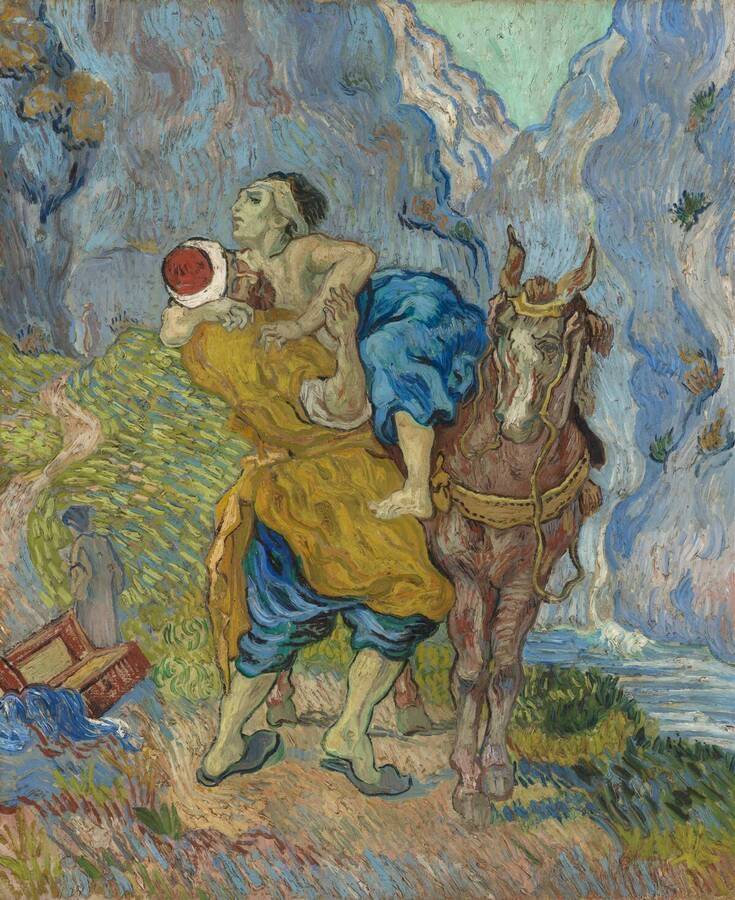
The painting The Good Samaritan (after Delacroix), created by Vincent van Gogh (1853–1890) in early May 1890 in Saint-Rémy-de-Provence, is in urgent need of conservation. Both the oil painting and the historically significant frame have been high on the museum's conservation wish list for many years. Unfortunately, the popularity of the painting has prevented its conservation until now, as it is always on display in the permanent Van Gogh presentation or on loan to other national or international museums. In 2025 and 2026, between two international loans, the opportunity to conserve the painting has finally arisen.
Modern interpretation
Van Gogh painted The Good Samaritan (after Delacroix) in Saint-Rémy-de-Provence, where he had been admitted to a psychiatric clinic. This work is remarkable because it is one of the few religious representations in his oeuvre. Van Gogh considered it an interpretation of a lithograph of the painting with the same title by Eugène Delacroix, whose work he admired. The lithograph, which brought him comfort, hung in his room at the clinic. Although he directly copied the scene, he gave the work a modern interpretation through his heavy brushstrokes and colourful palette. It is possible that this painting is an allusion to his brother Theo, his very own ‘Samaritan’ who was always ready to help him. This personal and symbolic aspect makes it an important work within Van Gogh's oeuvre.
Original frame
It is also one of six paintings by Van Gogh still in its original Jac. van den Bosch frame. These frames were made at the studio 't Binnenhuis in Amsterdam, where Helene Kröller-Müller had one type of frame made specifically for her Van Gogh collection. In the 1950s, most of the Van Gogh frames were replaced with modern ones, but at the beginning of this century it was decided to revert to the type of frames used in Kröller-Müller's era, in honour of the museum's founder. Where the original frames had been removed, replicas were made. The original frame of The Good Samaritan is therefore of historical importance to the Kröller-Müller collection.
 Current condition of the painting
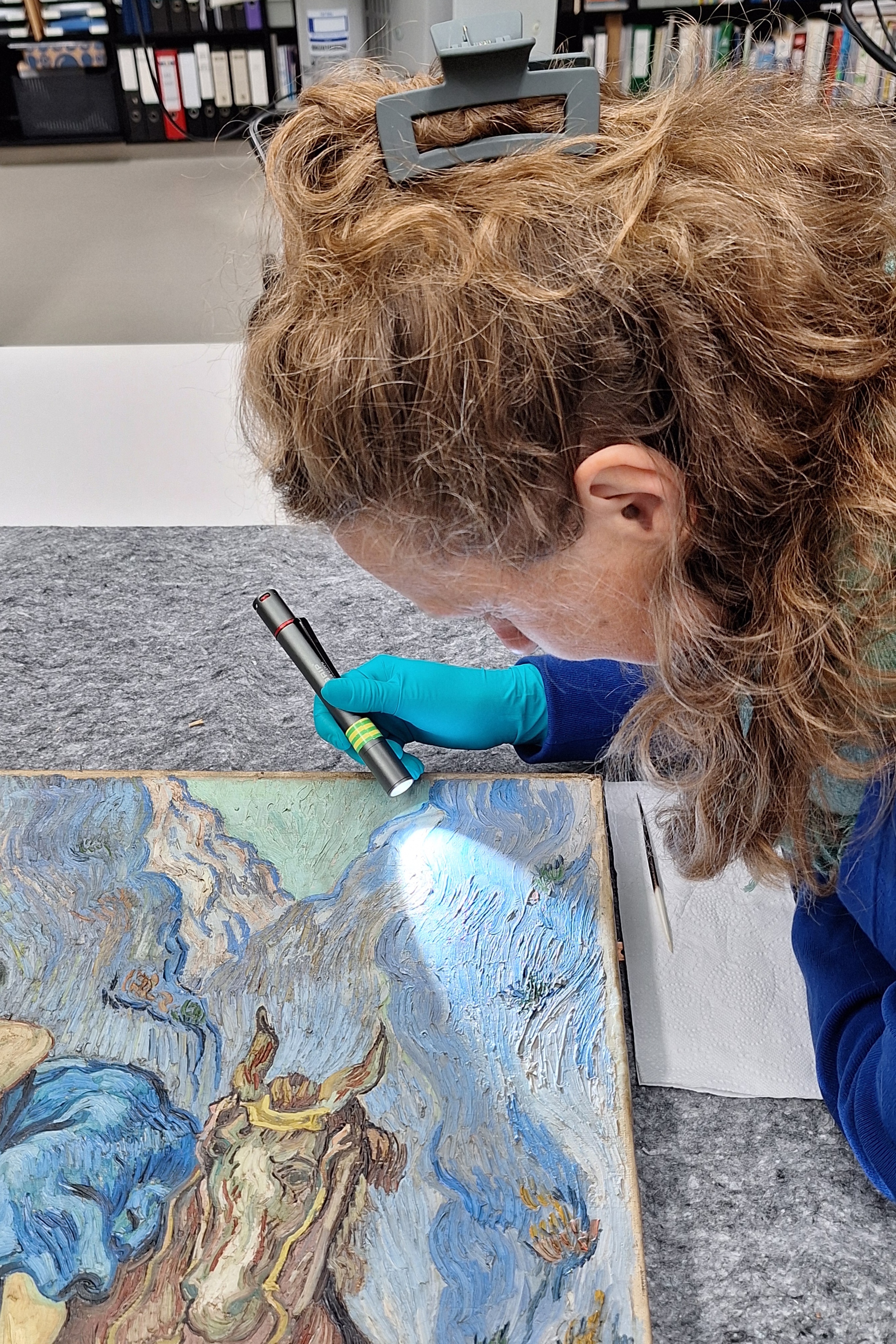
The painting has received a wax-resin relining in the past, probably in the 1970s. During this last major conservation treatment, the paint layer was also given a glossy varnish, which has yellowed considerably over the years. Moreover, the varnish layer itself, the dirt under the varnish and the wax-resin residue from the relining are non-original materials on the painting. After all, the painting was originally unvarnished and unlined. The yellowed varnish has already been removed from many of our Van Gogh paintings, and it is a long-cherished desire to also be able to show this painting (as much as possible) in its original state to our visitors again.
Condition of the frame
The condition of the frame is moderate. The corner pieces are no longer perfectly square, resulting in open seams and movement in the joints. Tension in the wood has caused cracks, for example in the bottom left corner of the moulding and in the end wood at the corners. The top right corner was damaged at some point, whereby a large piece of wood was lost. The frame is unstable due to tension in the wood and movement in the corner joints, which is problematic because the painting travels regularly. The finish layer has also deteriorated significantly and even disappeared in places, with dull areas and distracting black spots.
Proposed treatment of the painting
During the conservation of the painting, the yellowed varnish layer will be removed. Wax/resin residues under the varnish layer, which are often present around the impasto areas, will also be removed. It is not yet clear what is causing the locally occurring grey discolouration and whether this layer can be removed. In some places, there are raised flakes of paint that have adhered well due to the earlier wax/resin lining. After removing the varnish layer, the possibility of flattening these raised flakes of paint will be examined. There are some old lacunae in the paint layer that have surprisingly never been filled and retouched in the past. If it can be established that these are not original damage, they will be filled and retouched after the removal of the varnish, so they can be integrated into the representation again.
Proposed treatment of the frame
The frame needs to be dismantled for its restoration. The mouldings will be adjusted to better fit the distorted corner pieces. In addition, the crack at the bottom left, the cracks at the dowels and on the end wood of the corner pieces will be stabilised. The frame will then be reassembled and treated. The spots and remnants of the old finish will be removed as much as possible, after which a new finish with multiple layers of wax will be applied. The restoration of the damaged upper right corner, where maple wood is missing, has yet to be determined. Repairing it would restore the contours and give the frame a more inconspicuous appearance, but it is also desirable to restore the frame with restraint, so that its age remains visible.
The conservation work is made possible thanks to the support of the Stichting Bonhomme Tielens, the Pruikenburg Fonds, and the Helene Kröller-Müller Fund.